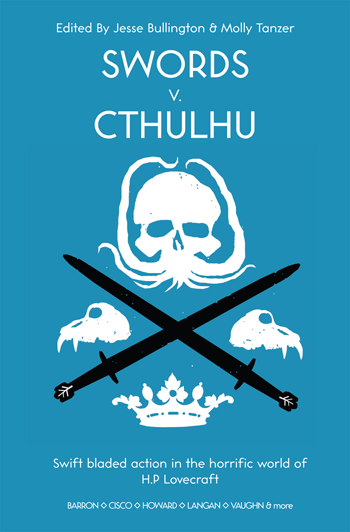
Here’s a peek at the cover for Shotguns v. Cthulhu, our upcoming anthology of action-oriented Lovecraftian tales. Jason Morningstar brilliantly captured the bold, graphic look we’re pursuing for the line with his double-barreled, multi-tentacled retake of the skull and crossbones motif. Sans text, the design would look great on a T-shirt. Alas, that’s a category of merchandise publishers have difficulty shifting, so you’ll just have to keep an eye out for the book when it arrives later in 2012.
Here’s a peek at the cover for The New Hero. We were lucky enough to snag the services of comics artist and illustrator extraordinaire Gene Ha, who more than met our expectations with the fabulous image you see below.
Gene went above and beyond the call of duty by closely reading each and every one of the fourteen great stories in the collection, placing each protagonist in his composition. He pitched us the idea of a Greek vase as emblematic of the book’s theme, which combines the time-honored structure of the iconic hero tale with fresh new characters, settings, and voices. The individual elements will also appear in the interior, as part of the title treatment for each story.
The first volume of a new line carries a lot of freight. We couldn’t be more thrilled.
Graeme Davis’ love of classic aviation shines through every narrative rivet and spanner of “Against the Air Pirates”, his perfectly evoked 30s South Sea adventure genre, featured in The New Hero.
“Anyone who has known me for any length of time will be able to tell you that I’m a plane geek. Specifically, a vintage plane geek. More specifically still, a 30s and 40s plane geek. I can bore the pants off anyone with trivia about obscure WWII fighters like the Commonwealth Boomerang and lost designs like the Grumman Skyrocket. If the Westland Whirlwind had been fitted with Merlin engines instead of those wimpy Peregrines, would the Mosquito have even flown?”
Fly over to his blog for more…
Rob Heinsoo renews his intellectual poaching license as he shares the genesis of “Old Wave”, his evocative story for Shotguns v. Cthulhu.
The biggest obstacle confronting writers who already possess the talent, sensibility, and discipline required to do good work is the eternal battle against self-doubt. Quality writing depends on the ability to oscillate between creative and critical thinking. Creative to get the material on the page in the first place, critical to shape and improve it during rewrites.
Yet all too often the critical overwhelms the creative, leading to the rabbit hole of obsessive, non-improving revision. Or worse, the dread paralysis we know as writer’s block. One way to allow self-appraisal to curdle into self-laceration is to privilege outside pronouncements over your own judgment.
A goodly chunk of writing advice unwittingly falls into that category. What is often couched as sharply etched tough love can screw with your judgment, especially when your brain is currently casting about for ways to undermine you.
Writing advice can adopt a harshly declarative or unnecessarily categorical tone for a couple of reasons. Most obviously, there’s a big audience for writing advice, which is more entertaining to read when it’s punchy and unequivocal.
Another less apparent reason is that it’s often written out of frustration with willfully clueless would-be writers who don’t have the above-mentioned qualities and are unlikely to ever acquire them. The clumsily confrontational cover letters and howler-strewn prose of the strictly aspirational writer provide perfect bad examples for a “don’t do this” list.
The extreme cases are memorable, but they’re at best unready for real help. Notes warning you to avoid insulting your prospective publisher or submitting unproofed first drafts don’t reach the people who stand to benefit from them.
When deciding whether to let a piece of advice to take up residence in your personal rule book, look for practical tips that make good work better. Distrust flagellations and exhortations. Even when they make good points, the emotional charge behind them may do more to mystify the process and overfeed your voice of doubt than to spur you to a new breakthrough.
Be sure, above all, that the advice you’re taking on board isn’t a case of the writer spreading his or her self-doubt to others. That stuff’s contagious, man.
Over on his blog, Kenneth Hite talks about his New Hero story “Bad Beat For Aaron Burr,” highlighting the alternate history his story cleverly situates in evocative background detail.
The centerpiece of our first and third anthologies is the iconic hero: the serial character who does not undergo a story arc, but instead remains steadfast against pressure to change. Instead, the iconic hero changes the world, resolving disorder and solving problems.
A character can conform to this pattern without having multiple adventures. You don’t see it often, because readers and viewers expect the protagonist of a standalone work to be a dramatic hero, who does transform.
Ree Dolly, the heroine of the book and movie Winter’s Bone, proves the point.
Spoilers ahead…
Continue reading »
Yesterday I unveiled the table of contests for The New Hero.
It is our mission to bring you exciting fiction that crosses genres and writing scenes. Our hope is that we can extend the community spirit we take for granted in the tabletop roleplaying scene to a distinctive and surprising fiction line. Toward that end, I thought I’d take you behind the scenes a little bit for a look at the process of ordering the stories.
With The New Hero, I had an unusual luxury: we commissioned a follow-up volume at the same time. Volume Two will be our third release, after Shotguns v. Cthulhu. Most of the stories for that are also already in hand, and again I’m extremely pleased with the results.
One of my high-class problems in putting these books together is that the list of folks I’d like to work with is too long. Just the RPG folks alone could more than fill two books. Also we want to bring in select writers from the F/SF, literary and media worlds. Doing the two books at once gave me greater flexibility than I’d normally have in building an ideal balance of writers and stories.
In dividing stories between volumes I’ve had to make sure that both are equally impressive, but this part of the task proved unexpectedly easy. The overall quality of the work exceeded my expectations, sparing me the need to find unobtrusive slots for merely acceptable pieces.
Instead I found myself balancing by genre, and by writing scene. The New Hero books are based on a structural premise, not a generic one. Each concerns an iconic hero who is not changed by the world, but instead restores order and changes the world by remaining true to his or her essential values. (I’ve talked about this before on my personal blog and in Hamlet’s Hit Points.
For example, contemporary supernatural stories proved very popular with writers. This is unsurprising, considering the heat surrounding this genre at the moment. Stories fitting this vibe had to be roughly divided between the two books.
Once I had the divisions down, I then had to determine the story order. That’s where I got all charty. As is my wont, I dragged Profantasy’s Campaign Cartographer kicking and screaming from its map-making function to serve my sinister diagram-making purposes. If you don’t know it, it’s a CAD based program that allows you to treat each item in a map or diagram as a separate unit, allowing you to easily move them around and transform them at needed. Its symbol function permits the easy import of symbols from PNG files. With this I was able to create images that served as quick visual reminders of the various considerations I had to balance while ordering the stories.
The factors, in addition to genre and writing scene, were:
- narrative view (first or third person)
- tense (past or present)
- tone (up or downbeat)
- story length
I also found that several of the stories shared broadly similar premises. Given that there are only so many distinct McGuffins that a hero can pursue, I don’t see this as a problem—so long as they don’t show up right next to one another.
On the chart, the symbols after the box listing the story, author and genres are view, tense, tone, premise, and length.
So that’s a total of seven factors to consider in arranging fourteen stories for one anthology. I started knowing I want to slot certain stories into particular key locations. From there I juggled and rejuggled the remaining entries, seeking to distribute the rarer entries, throughout the book.
I imagine the process of ordering tracks for an album relies on a similar matrix of considerations: length, tempo, likely hits, distribution of voices for a band with multiple vocalists, and so on.
After all the prep, the eventual cascade of choices fell together quickly. Then came the final tinkering phase. It reminded me of picking film festival tickets at TIFF. As with TIFF, I can’t imagine doing it without the chart.
Jeff Tidball provides a flash excerpt of his New Hero story. “Better Off Not Knowing”, over on his tumblr blog. Check it out.
Stone Skin Press proudly announces the table of contents for The New Hero, our first short fiction anthology:
Ezekiel Saw the Wheel, Julia Bond Ellingboe
Better Off Not Knowing, Jeff Tidball
Warrior of the Sunrise, Maurice Broaddus
The Midnight Knight, Ed Greenwood
The Thirty-Ninth Labor of Reb Palache, Richard Dansky
On Her Majesty’s Deep Space Service, Jonny Nexus
Cursebreaker: The Jikininki and the Japanese Jurist, Kyla Ward
Against the Air Pirates, Graeme Davis
Fangs and Formaldehyde, Monica Valentinelli
Bad Beat for Aaron Burr, Kenneth Hite
Charcuterie, Chuck Wendig
Sundown in Sorrow’s Hollow, Monte Cook
A Man of Vice, Peter Freeman
The Captain, Adam Marek
This genre-spanning collection unleashes writers from diverse writing scenes to tackle the timeless structure of the iconic hero story. Release date TBA.